


Have you ever been in a room, heard a person entering, and by the sound of their footsteps, know who that person is without hearing their voice? That’s how it is for me, seated at my desk in the Kankakee Sands office! I can tell who is coming into the office because each of my coworkers has their own gate; as they round the corner, I can be ready with my good morning greeting for each of them.
That’s also how it is for me when I am out at Conrad Station Savanna with the woodpeckers! When I hear the drumming on the oak trees, I know which species of woodpecker to look up into the tree and say hello to.
The Sound of Spring: Listening for Red-Headed Woodpeckers
Several species of woodpeckers create the percussion section of Conrad Station Savanna’s spring-time orchestra: the downy woodpecker, hairy woodpecker, and the red-bellied woodpecker are common occurrences, and the large striking piliated woodpecker is sometimes heard, too! However, of all these, the most commonly heard woodpecker at Conrad Station Savanna--and my personal favorite--is the red-headed woodpecker (Melanerpes erythrocephalus).
How to Identify a Red-Headed Woodpecker
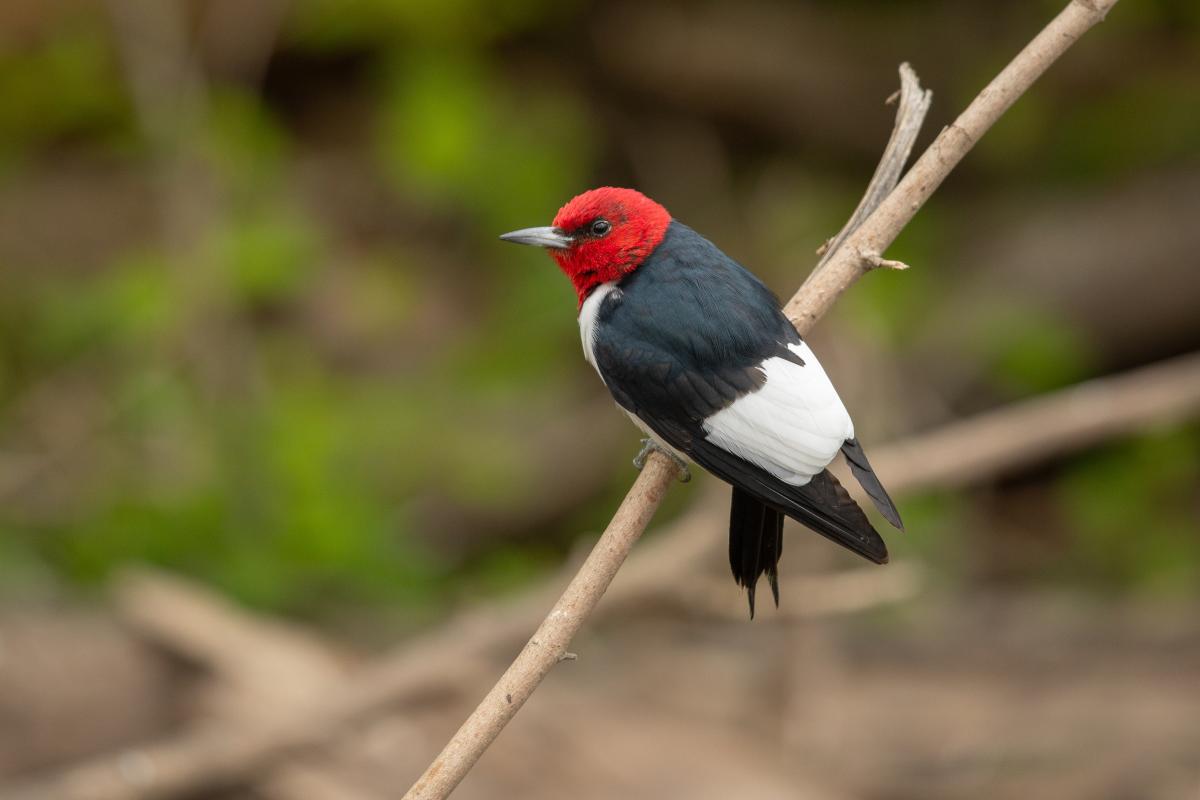
The red-headed woodpecker has an unmistakable pattern of feathers: a brilliant red head, black back and wings, with a white belly and rump. Adult males and females look alike. Both are approximately nine inches in length and have a stocky build. Juveniles have similar black-and-white body markings, have a brown streaked head instead of red, and are a little smaller in size.
Whenever I am out at Conrad and hear the unmistakable 1-second burst of rapid drumming repeated a few times in succession, I know red-headed woodpeckers are nearby.
Why Woodpeckers Drum and Peck
Woodpeckers drum most often in the spring to attract a mate. Tapping involves using their beak as a hammer on a hollow tree. The sound reverberates in the tree’s open chamber, and the sound carries over long distances. Often, I can hear the woodpeckers, yet I can’t see them because they are so far away!
All woodpeckers peck on trees to access the insects that are living in and under the bark of the tree. They use their long, barbed, sticky tongues to reach deep into holes and fish out insects, lessening the amount of drilling they need to do with their beaks.
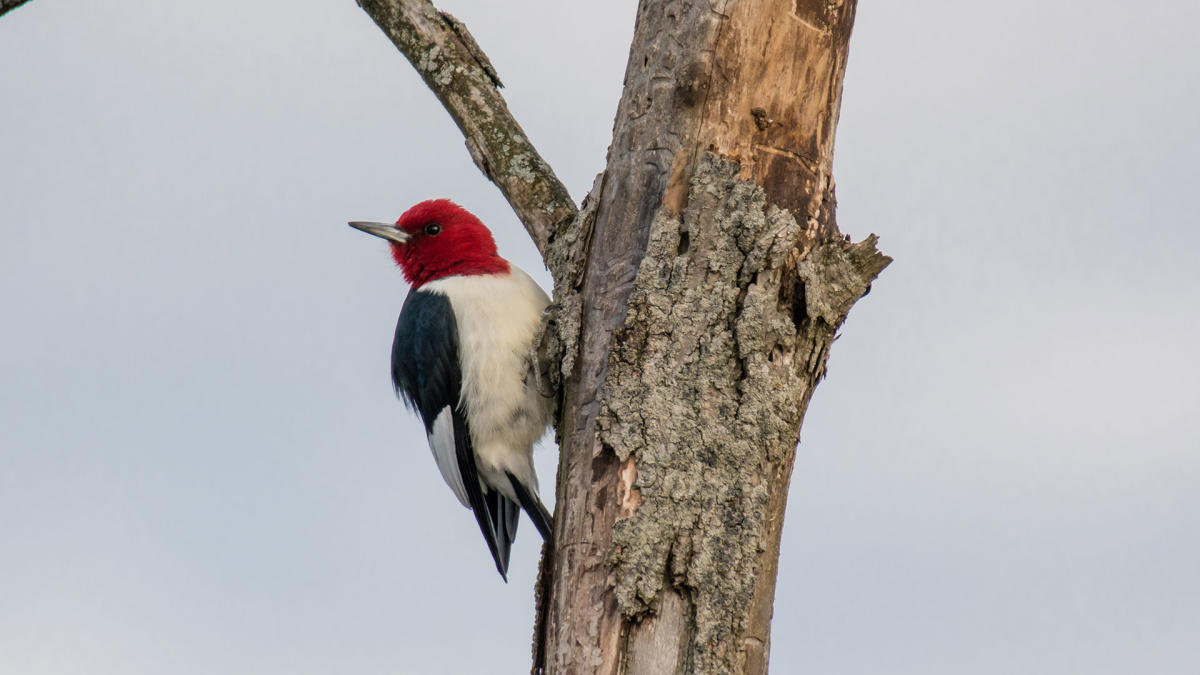
Other reasons that you might see a woodpecker poking and probing along tree trunks are to access other foods that comprise their diet, such as berries, insects, seeds, nuts, bird eggs, and even mice! Yes, mice! They may also be returning to a cache of insects and seeds that they had stored in the cracks and crevices of the tree’s bark to be eaten at a later time.
If all this talk of eating from the sides of trees has your head spinning, you can imagine the headache you might have after a day of hammering on a tree with your beak! Rest assured that red-headed woodpeckers, like all woodpeckers, have bodies well-adapted to a life of foraging and hammering on trees. To absorb the shock of hammering, the woodpeckers’ brain case is larger than that of other birds, and their frontal bones are more folded to act as shock absorbers.
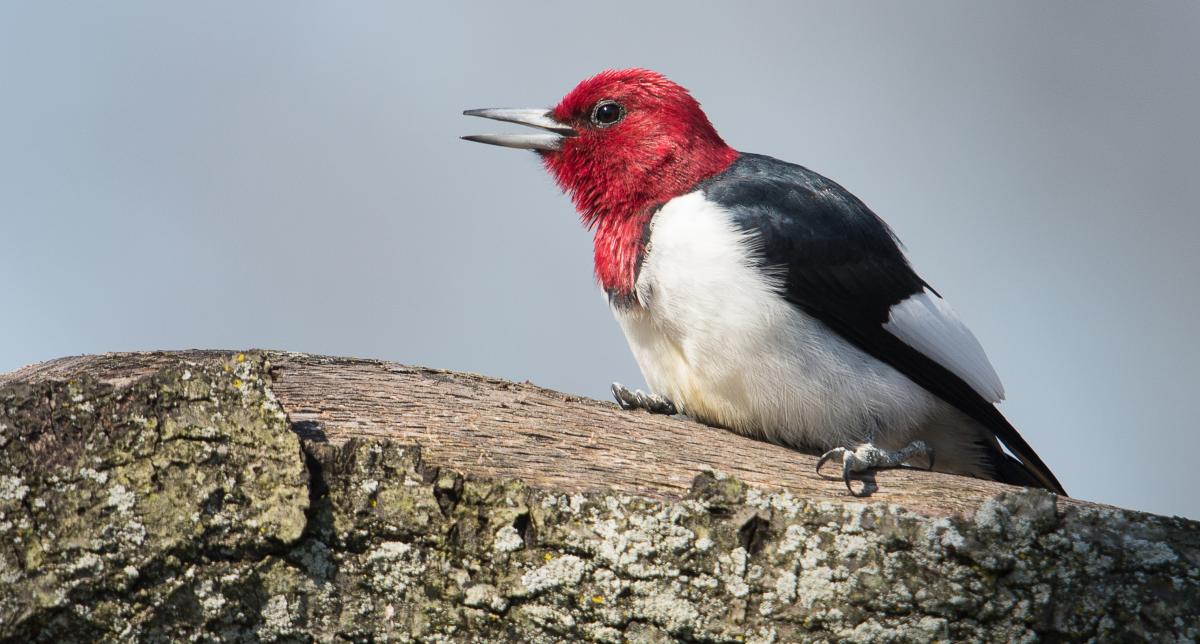
Like us chatty humans, red-headed woodpeckers use their voice to communicate. They use a (read this next part aloud) wheezy, loud queeah or queerp to communicate to other woodpeckers who are far away and a gentle dry rattle krrrrrr to communicate to buddies who are close by.
Red-Headed Woodpeckers and Habitat Restoration
Unfortunately, red-headed woodpeckers are declining at an alarming rate of four percent annually in the Midwest. However, at Conrad Station Savanna red-headed woodpeckers are thriving in their preferred habitat of burned, deciduous woodlands of oak with large open areas between the trees. We hope to encourage those numbers to increase as we work this year to continue to improve habitat at Conrad Station Savanna, just as we staff have been doing over the past 30 years at Conrad.
This year, from April to October, we will be hosting a series of Weed Wrangles© at Conrad Station Savanna on the fourth Friday of each month from 9 am to noon. Our focus will be removing undesirable, non-native, invasive plants in an effort to make more suitable, desirable habitat for the red-headed woodpeckers who prefer open oak woodlands with large open areas between the trees. Through these family-friendly volunteer workdays, we strive to have fun working together to make the woods a more open, easy flying place for our woodpecker colleagues.
If you are itchin’ to see and hear a red-headed woodpecker, early spring is a great time! It is warm enough for a leisurely walk along the 1.5 mile Conrad Station Savanna trail and because the leaves on the trees have not yet emerged, it’s often much easier to catch a glimpse of this stunning bird in spring than in the summer. Will you see and hear them… (insert drum roll)… we surely hope so! And when you do, be sure to say “hi”!
For more information on the Weed Wrangles© at Conrad Station Savanna, visit nature.org/volunteer. ___________________________________________________________________________
The Nature Conservancy’s Kankakee Sands of Indiana and Illinois is 10,000 acres of prairie and savanna habitat in Northwest Indiana and Northeast Illinois, open every day of the year for public enjoyment. For more information, visit www.nature.org/KankakeeSands or call the office at 219-285-2184. To receive a copy of our quarterly newsletter with events and activities at Kankakee Sands, send an email to anyberg@tnc.org.
More Nature Blogs

Red-Headed Woodpeckers Are a Sign of Spring in Northwest Indiana
Have you ever been in a room, heard a person entering, and by the sound of their footsteps, know who…

March at Kankakee Sands: Wetlands, Bison, and Signs of Spring
It’s March! And there is so much to be glad about – the great greening up of the…

New Audio Tour at Kankakee Sands Makes Exploring Easier
Have you been to Kankakee Sands and fallen head over heels in love with the prairie and bison?…

Winter Evenings at Kankakee Sands: Watching Short-Eared Owls Take Flight
Feel like adding a little joy to your day? A late afternoon walk or drive at Kankakee Sands, amidst…

How to Identify Swallowtail Butterflies in Northwest Indiana
Our August skies are aflutter with butterflies over the Kankakee Sands prairie. The nectar-rich…

Meet the Beavers of Kankakee Sands: Wetland Wonders in Northwest Indiana
Summertime is swimming time in Indiana. Perhaps you enjoy swimming in an outdoor pool, creek, or one…

Training Future Conservationists at Kankakee Sands
It’s September, and it’s back-to-school time for many students and families. My own…
