


Our August skies are aflutter with butterflies over the Kankakee Sands prairie. The nectar-rich flowers of the blazing stars, milkweeds, and bonesets are decorated by the wings of various butterflies, including swallowtails.
A fun (and sometimes challenging) part of being among so many butterflies is trying to identify them. A good place to start is the larger forewings, which are closer to the head, and the two smaller hind wings, nearer its bum. We can view the wings from above, which may have a particular pattern, or view from below, which may have a different pattern altogether!

A few pro-tips to butterfly watching:
-
Butterflies are fast fliers! You might do well to wait until they settle down on a flower rather than try to run after them. Running in a prairie can be a tripping hazard!
-
Find a nice patch of flowers in full bloom and take a seat. On a warm day, often the butterflies will find you.
-
When they are relaxed and comfortable, they will often spread their wings open, giving you a nice view of their wing pattern.
-
When they are hot, they often fold their wings in, giving the admirer a good view of the underside of the wings.
-
And remember that when the wings are closed, you often have a nice view of the butterfly’s body, which can be a variety of colors with spots, lines, or dots.
Feeling good about ID’ing butterflies? Let’s take it to the next level and try to identify the three different swallowtail species commonly found in Northwest Indiana. All three swallowtails have a tell-tale tail that identifies them as being a swallowtail. This appendage is an extension of the hindwing, which is thought to lure predators to nibble the less important back wing of the butterfly, rather than the important head and antennae.
I have found that telling swallowtails apart can be a little tricky, yet they have relatively easily observable differences that can be seen both in flight and while resting, that allow you to tell one from the other.
Black Swallowtail Identification

The black swallowtail (Papilio polyxenes asterius) feeds on plants in the carrot family, such as parsley and Queen Anne’s lace. Perhaps you have seen them in your own garden? If you have, then you’ve seen the green striped caterpillar. Should you try to pick it up, get ready to be startled by fleshy orange horns that spring out from the head in an effort to scare you into dropping it!
When the butterfly is at rest with its wings open, you will note two rows of yellow spots all along the outside of the wing margin, and a blush of blue on the hindwings. If you get a chance to see the black swallowtail with its wings folded together above its body, you will find that it has a dark body with yellow spots on its abdomen.
Spicebush Swallowtail Identification
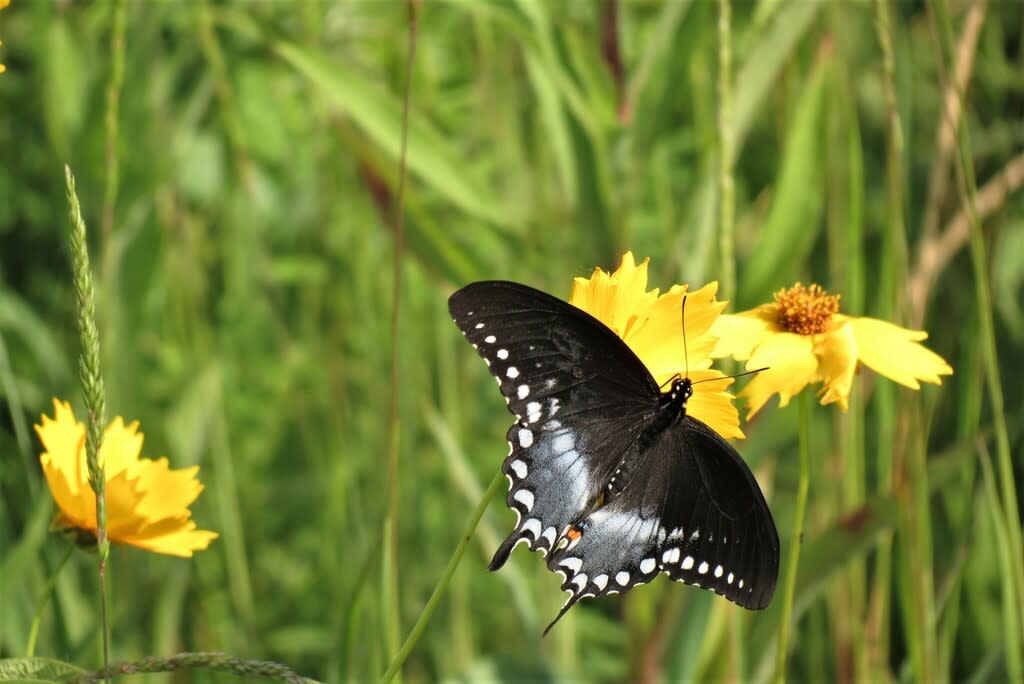
The Spicebush swallowtail (Papilo triolus triolus) feeds on, no surprise, spicebush!, and also on sassafras trees.
When viewed from above with its wings open, this butterfly also has dark wings like the black swallowtail. However, it has only one row of pale spots. When the wings are folded, you are afforded a nice view of the wings’ undersides, which reveal two orange spots along the edges of the hindwing. Look closely – one orange spot is missing and in its place is a splash of blue, often referred to as a blue shooting star. The abdomen and torso of the spicebush swallowtail are adorned with yellow spots on both – super cool looking!
Eastern Tiger Swallowtail Identification

Eastern tiger swallowtail (Papilio glaucus) feeds on a variety of woody plants, such as wild cherry, willow, and birch. Eastern tiger swallowtail keeps us on our toes by having two forms to know: a yellow form and a dark form!
Yellow form Eastern tiger swallowtail butterflies have wings which, when viewed from above, are yellow with black tiger-like stripes. The yellow is bounded by black, and on the edge of the wings in this black border is one row of yellow spots. Gorgeously, the body of the yellow form is also yellow with black tiger-stripe markings.
Dark form Eastern tiger swallowtail butterflies are always female; no males exhibit this color pattern. When viewed from above, the forewings of the female butterfly are all dark grey-black in color with just one row of yellow spots along the edge of the wings. In addition to the dark wings, its body is also dark and lacks markings.
If you get these facts down, should a bird nibble off those pretty little tails, you’ll still be able to tell one swallow from the next! Some of my favorite go-to butterfly identification books are “Butterflies of Indiana” by Jeffrey Belth, “Butterflies of Tennessee” by Rita Venable, and “Butterflies through Binoculars” by Jeffrey Glassberg.
Want to learn more about butterflies, specifically the iconic monarch? You, your friends, and your family are invited to TNC's eighth annual Festival de la Monarca in East Chicago on Saturday, September 6, 2025. TNC and our partners will welcome the monarch butterflies as they journey across northwest Indiana on their way to Mexico. This festival is FREE and open to all! Come celebrate with educational exhibits, fun activities, music, art, dance, and food—as well as TNC's Monarch Experience. Learn more by visiting nature.org/events.
_______________________________________________________________________________
The Nature Conservancy’s Kankakee Sands is an 8,400-acre prairie and savanna habitat in Northwest Indiana, open every day of the year for public enjoyment. It’s an exciting year for Kankakee Sands, as we are making major improvements to popular areas within the preserve. If you plan to visit, please check our Facebook page to see if any of the areas you want to see will be impacted by the construction. For more information about Kankakee Sands, visit www.nature.org/KankakeeSands or call the office at 219-285-2184.
More Nature Blogs

Red-Headed Woodpeckers Are a Sign of Spring in Northwest Indiana
Have you ever been in a room, heard a person entering, and by the sound of their footsteps, know who…

March at Kankakee Sands: Wetlands, Bison, and Signs of Spring
It’s March! And there is so much to be glad about – the great greening up of the…

New Audio Tour at Kankakee Sands Makes Exploring Easier
Have you been to Kankakee Sands and fallen head over heels in love with the prairie and bison?…

Winter Evenings at Kankakee Sands: Watching Short-Eared Owls Take Flight
Feel like adding a little joy to your day? A late afternoon walk or drive at Kankakee Sands, amidst…

How to Identify Swallowtail Butterflies in Northwest Indiana
Our August skies are aflutter with butterflies over the Kankakee Sands prairie. The nectar-rich…

Meet the Beavers of Kankakee Sands: Wetland Wonders in Northwest Indiana
Summertime is swimming time in Indiana. Perhaps you enjoy swimming in an outdoor pool, creek, or one…

Training Future Conservationists at Kankakee Sands
It’s September, and it’s back-to-school time for many students and families. My own…
